

Who Led The Texans In Drawing Santa Anna Into A Trap At The Battle Of Jacinto?
| Battle of San Jacinto | |||||||
|---|---|---|---|---|---|---|---|
| Role of the Texas Revolution | |||||||
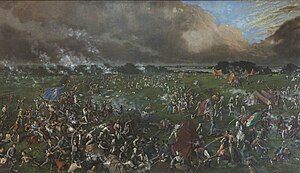 The Battle of San Jacinto – 1895 painting past Henry Arthur McArdle (1836–1908)[1] | |||||||
| |||||||
| Belligerents | |||||||
 Mexican Republic Mexican Republic | Republic of Texas | ||||||
| Commanders and leaders | |||||||
 |
| ||||||
| Strength | |||||||
|
| ||||||
| Casualties and losses | |||||||
|
| ||||||
| guess location of the battle class=notpageimage| Location within Texas | |||||||
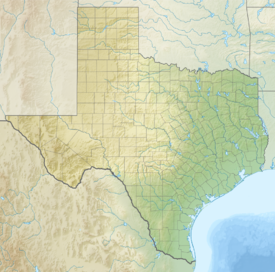

The Battle of San Jacinto (Spanish: Batalla de San Jacinto), fought on April 21, 1836, in present-day La Porte and Pasadena, Texas, was the final and decisive battle of the Texas Revolution. Led by General Samuel Houston, the Texan Army engaged and defeated General Antonio López de Santa Anna's Mexican army in a fight that lasted merely 18 minutes. A detailed, first-hand business relationship of the boxing was written by General Houston from the headquarters of the Texan Regular army in San Jacinto on Apr 25, 1836.[three] Numerous secondary analyses and interpretations accept followed.
General Santa Anna, the president of Mexico, and General Martín Perfecto de Cos both escaped during the boxing. Santa Anna was captured the next day on Apr 22 and Cos on Apr 24. After being held for virtually 3 weeks as a pow, Santa Anna signed the peace treaty that dictated that the Mexican regular army exit the region, paving the way for the Commonwealth of Texas to become an independent country. These treaties did non necessarily recognize Texas as a sovereign nation but stipulated that Santa Anna was to vestibule for such recognition in Mexico City. Sam Houston became a national celebrity, and the Texans' rallying cries from events of the war, "Recollect the Alamo" and "Retrieve Goliad" became etched into Texan history and legend.
Background: Dec 1832 – March 1836 [edit]
Mexican constitution overturned [edit]
General Antonio López de Santa Anna was a proponent of governmental federalism when he helped oust Mexican President Anastasio Bustamante in Dec 1832. Upon his election equally president in April 1833,[four] Santa Anna switched his political ideology and began implementing centralist policies that increased the disciplinarian powers of his office.[5] His abrogation of the Constitution of 1824, correlating with his abolishing local-level say-so over Mexico's state of Coahuila y Tejas (Coahuila and Texas), became a flashpoint in the growing tensions between the central government and its Tejano and Anglo citizens in Texas. While in Mexico City pending a meeting with Santa Anna, Texian empresario Stephen F. Austin wrote to the Béxar ayuntamiento (city council) urging a pause-away land. In response, the Mexican government kept him imprisoned for most of 1834.[6] [7]
Colonel Juan Almonte was appointed director of colonization in Texas,[8] ostensibly to ease relations with the colonists and mitigate their anxieties about Austin'southward imprisonment.[9] He delivered promises of cocky-governance and conveyed regrets that the Mexican Congress accounted it constitutionally impossible for Texas to be a divide state. Behind the rhetoric, his covert mission was to identify the local power brokers, obstruct whatever plans for rebellion, and supply the Mexican regime with data that would be of use in a armed forces disharmonize. For nine months in 1834, under the guise of serving every bit a regime liaison, Almonte traveled through Texas and compiled an all-encompassing intelligence study on the population and its environment, including an cess of their resources and defense capabilities.[10]
Cos is appointed military governor of Texas [edit]
In consolidating his power base, Santa Anna installed Full general Martín Perfecto de Cos as the governing military machine authority over Texas in 1835.[xi] [12] Cos established headquarters in San Antonio on October nine, triggering what became known as the Siege of Béxar.[thirteen] Subsequently two months of trying to repel the Texian forces, Cos raised a white flag on December 9 and signed surrender terms two days later on.[xiv] The surrender of Cos effectively removed the occupying Mexican army from Texas. Many believed the war was over, and volunteers began returning home.[15]
In compliance with orders from Santa Anna, Mexico's Minister of War José María Tornel issued his Dec thirty "Round No. 5", often referred to every bit the Tornel Decree, aimed at dealing with United States intervention in the uprising in Texas. It alleged that foreigners who entered United mexican states for the purpose of joining the rebellion were to be treated as "pirates", to be put to decease if captured. In adding "since they are not subjects of any nation at state of war with the republic nor do they militate under whatever recognized flag," Tornel avoided declaring war on the The states.[16] [17]
Santa Anna takes the Alamo [edit]
The Mexican Army of Operations numbered 6,019 soldiers[eighteen] and was spread out over 300 miles (480 km) on its march to Béxar. Full general Joaquín Ramírez y Sesma was put in command of the Vanguard of the Accelerate that crossed into Texas.[nineteen] Santa Anna and his adjutant-de-military camp Almonte[20] forded the Rio Grande at Guerrero, Coahuila on February 16, 1836,[21] with Full general José de Urrea and 500 more troops following the next 24-hour interval at Matamoros.[22] Béxar was captured on Feb 23, and when the assail commenced, attempts at negotiation for surrender were initiated from inside the fortress. William B. Travis, the garrison commander, sent Albert Martin to request a coming together with Almonte, who replied that he did not have the authorization to speak for Santa Anna.[23] Colonel James Bowie dispatched Green B. Jameson with a letter, translated into Castilian past Juan Seguín, requesting a coming together with Santa Anna, who immediately refused. Santa Anna did, however, extend an offer of amnesty to Tejanos within the fortress. Alamo non-combatant survivor Enrique Esparza said that nearly Tejanos left when Bowie brash them to accept the offering.[24]
Cos, in violation of his give up terms, forded into Texas at Guerrero on February 26 to join with the principal regular army at Béxar.[25] Urrea proceeded to secure the Gulf Coast and was victorious in two skirmishes with Texian detachments serving under Colonel James Fannin at Goliad. On February 27 a foraging detachment under Frank W. Johnson at San Patricio was attacked by Urrea. Sixteen were killed and xx-ane taken prisoner, only Johnson and four others escaped.[26] [27] Urrea sent a company in search of James Grant and Plácido Benavides who were leading a company of Anglos and Tejanos towards an invasion of Matamoros. The Mexicans ambushed a grouping of Texians, killing Grant and nigh of the visitor. Benavides and iv others escaped, and six were taken prisoner.[28] [29]
The Convention of 1836 met at Washington-on-the-Brazos on March 1.[30] The following day, Sam Houston's 42nd birthday, the 59 delegates signed the Texas Declaration of Independence and chose an ad acting government.[30] [31] When news of the proclamation reached Goliad, Benavides informed Fannin that in spite of his opposition to Santa Anna, he was still loyal to Mexico and did non wish to help Texas pause away. Fannin discharged him from his duties and sent him home.[32] On March 4, Houston's military authorisation was expanded to include "the land forces of the Texian army both Regular, Volunteer, and Militia."[33]
At 5 a.m. on March 6, the Mexican troops launched their concluding assault on the Alamo. The guns barbarous silent xc minutes later; the Alamo had fallen.[34] Survivors Susanna Dickinson, her daughter Angelina, Travis' slave Joe, and Almonte'south cook Ben were spared by Santa Anna and sent to Gonzales, where Texian volunteers had been assembling.[35]
Texian retreat: the Runaway Scrape [edit]
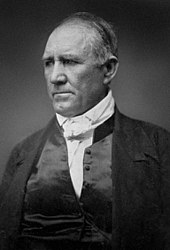
The same day that Mexican troops departed Béxar, Houston arrived in Gonzales and informed the 374 volunteers (some without weapons) gathered there that Texas was at present an contained republic.[36] Just after 11 p.one thousand. on March thirteen, Susanna Dickinson and Joe brought news that the Alamo garrison had been defeated and the Mexican army was marching towards Texian settlements. A hastily convened council of war voted to evacuate the area and retreat. The evacuation commenced at midnight and happened then quickly that many Texian scouts were unaware the army had moved on. Everything that could non be carried was burned, and the army'southward simply two cannon were thrown into the Guadalupe River.[37] When Ramírez y Sesma reached Gonzales the morning of March fourteen, he found the buildings however smoldering.[38]
Most citizens fled on foot, many carrying their pocket-size children. A cavalry company led by Seguín and Salvador Flores were assigned as rear guard to evacuate the more isolated ranches and protect the civilians from attacks by Mexican troops or Indians.[39] The further the army retreated, the more civilians joined the flying.[40] For both armies and the civilians, the step was slow; torrential rains had flooded the rivers and turned the roads into mud pits.[41]
As news of the Alamo's fall spread, volunteer ranks swelled, reaching nearly 1,400 men by March 19.[41] Houston learned of Fannin's surrender on March twenty and realized his army was the last hope for an independent Texas. Concerned that his ill-trained and ill-disciplined force would exist good for only one battle, and aware that his men could easily be outflanked past Urrea'due south forces, Houston continued to avoid engagement, to the immense displeasure of his troops.[42] By March 28, the Texian ground forces had retreated 120 miles (190 km) across the Navidad and Colorado Rivers.[43] Many troops deserted; those who remained grumbled that their commander was a coward.[42]
On March 31, Houston paused his men at Groce's Landing on the Brazos River.[Note 1] Two companies that refused to retreat farther were assigned to baby-sit the crossing.[44] For the next two weeks, the Texians rested, recovered from disease, and, for the first time, began practicing military machine drills. While in that location, two cannon, known equally the Twin Sisters, arrived from Cincinnati, Ohio.[45] Interim Secretary of War Thomas Rusk joined the camp, with orders from President David G. Burnet to supercede Houston if he refused to fight. Houston quickly persuaded Rusk that his plans were audio.[45] Secretary of Country Samuel P. Carson advised Houston to go along retreating all the fashion to the Sabine River, where more volunteers would likely flock from the U.s. and allow the regular army to counterattack.[Note ii] [46] Unhappy with everyone involved, Burnet wrote to Houston: "The enemy are laughing you lot to contemptuousness. Yous must fight them. You must retreat no further. The country expects you to fight. The salvation of the state depends on your doing so."[45] Complaints within the army camp became so strong that Houston posted notices that anyone attempting to usurp his position would be courtroom-martialed and shot.[47]
Santa Anna and a smaller forcefulness had remained in Béxar. After receiving word that acting President Miguel Barragán had died, Santa Anna seriously considered returning to Mexico City to solidify his position. Fearfulness that Urrea's victories would position him as a political rival convinced Santa Anna to remain in Texas to personally oversee the final phase of the campaign.[48] He left on March 29 to bring together Ramírez y Sesma, leaving only a small force to concord Béxar.[49] At dawn on April 7, their combined force marched into San Felipe and captured a Texian soldier, who informed Santa Anna that the Texians planned to retreat further if the Mexican army crossed the Brazos River.[50] Unable to cross the Brazos because of the small company of Texians barricaded at the river crossing, on April 14 a frustrated Santa Anna led a force of most 700 troops to capture the interim Texas government.[51] [52] Government officials fled mere hours before Mexican troops arrived in Harrisburgh (now Harrisburg, Houston) and Santa Anna sent Almonte with fifty cavalry to intercept them in New Washington. Almonte arrived just as Burnet shoved off in a rowboat, bound for Galveston Isle. Although the boat was however within range of their weapons, Almonte ordered his men to hold their fire so every bit not to endanger Burnet's family.[53]
At this signal, Santa Anna believed the rebellion was in its concluding expiry throes. The Texian regime had been forced off the mainland, with no way to communicate with its regular army, which had shown no interest in fighting. He adamant to cake the Texian army'southward retreat and put a decisive end to the war.[53] Almonte'due south scouts incorrectly reported that Houston's ground forces was going to Lynchburg Crossing on Buffalo Bayou, in preparation for joining the regime in Galveston, so Santa Anna ordered Harrisburgh burned and pressed on towards Lynchburg.[53]
The Texian regular army had resumed their march eastward. On Apr 16, they came to a crossroads; ane road led north towards Nacogdoches, the other went to Harrisburgh. Without orders from Houston and with no give-and-take amongst themselves, the troops in the atomic number 82 took the road to Harrisburgh. They arrived on April eighteen, non long after the Mexican army's departure.[54] That same day, Deaf Smith and Henry Karnes captured a Mexican courier carrying intelligence on the locations and future plans of all of the Mexican troops in Texas. Realizing that Santa Anna had only a small-scale force and was non far away, Houston gave a rousing voice communication to his men, exhorting them to "Remember the Alamo" and "Recollect Goliad". His army then raced towards Lynchburg.[55] Out of business that his men might not differentiate betwixt Mexican soldiers and the Tejanos in Seguín's visitor, Houston originally ordered Seguín and his men to remain in Harrisburgh to guard those who were too ill to travel quickly. Subsequently loud protests from Seguín and Antonio Menchaca, the guild was rescinded, provided the Tejanos wear playing cards in their hats to place them as Texian soldiers.[56]
Battle [edit]

San Jacinto Battlefield with troop movements
The area forth Buffalo Bayou had many thick oak groves, separated by marshes. This type of terrain was familiar to the Texians and quite alien to the Mexican soldiers.[57] Houston's army, comprising 900 men, reached Lynch'due south Ferry mid-forenoon on April 20; Santa Anna's 700-man force arrived a few hours afterward. The Texians made military camp in a wooded surface area along the depository financial institution of Buffalo Bayou; while the location provided skillful cover and helped hide their full force, information technology besides left the Texians no room for retreat.[58] [59] Over the protests of several of his officers, Santa Anna chose to make camp in a vulnerable location, a plain near the San Jacinto River, bordered past woods on one side, marsh and lake on another.[57] [lx] The ii camps were approximately 500 yards (460 thou) autonomously, separated by a grassy surface area with a slight rise in the centre.[61] Colonel Pedro Delgado later wrote that "the camping ground of His Excellency'southward selection was in all respects, against military rules. Any youngster would have washed better."[62]
Over the next several hours, ii brief skirmishes occurred. Using the Twin Sisters, Texians won the offset, forcing a small group of dragoons and the Mexican artillery to withdraw.[57] [63] Mexican dragoons and then forced the Texian cavalry to withdraw. In the melee, Rusk, on foot to reload his rifle, was virtually captured by Mexican soldiers only was rescued by newly arrived Texian volunteer Mirabeau B. Lamar.[63] Over Houston's objections, many infantrymen rushed onto the field. As the Texian cavalry fell back, Lamar remained backside to rescue some other Texian who had been thrown from his horse; Mexican officers "reportedly applauded" his bravery.[64] Houston was irate that the infantry had disobeyed his orders and given Santa Anna a ameliorate estimate of their force; the men were as upset that Houston had not allowed a total battle.[65]
Throughout the night, Mexican troops worked to fortify their camp, creating breastworks out of everything they could find, including saddles and brush.[66] At 9 a.m. on April 21, Cos arrived with 540 reinforcements, bringing the Mexican force to approximately ane,200-1,500 men which outnumbered the Texian amass forces of approximately 800 men (official count entering battle was reported at 783).[67] General Cos' men were mostly raw recruits rather than experienced soldiers, and they had marched steadily for more than 24 hours with no residuum and no food.[68] As the forenoon wore on with no Texian attack, Mexican officers lowered their guard. By afternoon, Santa Anna had permitted Cos' men to sleep; his tired troops besides took advantage of the time to rest, swallow, and bathe.[69]
Not long after Cos arrived with reinforcements, Full general Houston ordered Smith to destroy Vince's Bridge (located nigh viii miles from the Texian encampment) to cake the only route out of the Brazos and, thereby, preclude any possibility of escape past Santa Anna.[70] Houston describes how he arrayed the Texian forces in preparation of battle: "Colonel Edward Burleson was assigned the center. The 2nd regiment, under the command of Colonel Sydney Sherman, formed the left-wing of the army. The artillery, under the special command of Col. Geo. W. Hackley, inspector full general, was placed on the right of the kickoff regiment, and iv companies under the command of Lieutenant Colonel Henry Millard, sustained the arms on the right, and our cavalry, sixty-ane in number and commanded by Colonel Mirabeau B. Lamar...placed on our extreme right, composed our line." [71]

The Texian cavalry was first dispatched to the Mexican forces' far left, and the artillery advanced through the tall grass to within 200 yards of the Mexican breastworks.[71] The Texian Twin Sisters fired at 4:30, starting time the battle.[72] After a single volley, Texians broke ranks and swarmed over the Mexican breastworks, yelling "Remember the Alamo! Recollect La Bahia (Goliad)!", to engage in paw-to-hand combat. Mexican soldiers were taken past surprise. Santa Anna, Castrillón, and Almonte yelled often conflicting orders, attempting to organize their men into some class of defence.[73] The Texian infantry forces advanced without halt until they had possession of the woodland and the Mexican breastwork; the right-wing of Burleson'south and the left-fly of Millard'southward forces took possession of the breastwork.[71] Inside 18 minutes, Mexican soldiers abandoned their campsite and fled for their lives.[74] The killing lasted for hours.[75]
Many Mexican soldiers retreated through the marsh to Peggy Lake.[Notation 3] Texian riflemen stationed themselves on the banks and shot at annihilation that moved. Many Texian officers, including Houston and Rusk, attempted to stop the slaughter, but they were unable to gain control of the men, incensed and vengeful for the massacres at the Alamo and Goliad, while frightened Mexican infantry yelled "Me no Alamo!" and begged for mercy to no avail.[76] In what historian Davis calls "1 of the most 1-sided victories in history",[77] 650 Mexican soldiers were killed and 300 captured.[78] 11 Texians died, with 30 others, including Houston, wounded.[79]
Although Santa Anna'due south troops had been thoroughly vanquished, they did not stand for the bulk of the Mexican army in Texas. An additional 4,000 troops remained under the commands of Urrea and General Vicente Filisola.[80] Texians had won the battle because of mistakes made past Santa Anna, and Houston was well aware that his troops would accept little promise of repeating their victory against Urrea or Filisola.[81] As darkness savage, a large group of prisoners was led into camp. Houston initially mistook the group for Mexican reinforcements and reportedly shouted out that all was lost.[82]
Mexican retreat [edit]
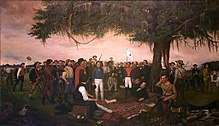
"Surrender of Santa Anna" by William Henry Huddle shows the Mexican president and general surrendering to a wounded Sam Houston, the Boxing of San Jacinto
Santa Anna had escaped towards Vince'due south Span.[83] Finding the bridge destroyed, he hid in the marsh and was captured the following day, wearing the uniform jacket of a private. This subterfuge was uncovered when other Mexican prisoners cried out in recognition of their commander.[78] He was brought before Houston, who had been shot in the ankle and badly wounded.[80] [Note 4] Texian soldiers gathered around, calling for the Mexican full general's immediate execution. Bargaining for his life, Santa Anna suggested that he society the remaining Mexican troops to stay away.[84] In a letter of the alphabet to Filisola, who was now the senior Mexican official in Texas, Santa Anna wrote that "yesterday evening [nosotros] had an unfortunate encounter" and ordered his troops to retreat to Béxar and await further instructions.[81]
Urrea urged Filisola to continue the campaign. He was confident that he could challenge the Texian troops. According to Hardin, "Santa Anna had presented Mexico with 1 armed services disaster; Filisola did non wish to take a chance some other."[85] Spring rains had ruined the ammunition and rendered the roads nearly impassable, with troops sinking to their knees in mud. The Mexican troops were shortly out of food and began to fall sick from dysentery and other diseases.[86] Their supply lines had broken downwards, leaving no promise of farther reinforcements.[87] Filisola later wrote "Had the enemy met usa under these cruel circumstances, on the only road that was left, no alternative remained but to die or surrender at discretion".[86]
For several weeks afterward San Jacinto, Santa Anna continued to negotiate with Houston, Rusk, and then Burnet.[88] Santa Anna suggested 2 treaties, a public version of promises made between the ii countries, and a private version that included Santa Anna's agreements. The Treaties of Velasco required that all Mexican troops withdraw due south of the Rio Grande and that all private property be respected and restored. Prisoners of war would be released unharmed, and Santa Anna would be given immediate passage to Veracruz. He secretly promised to persuade the Mexican Congress to admit the Republic of Texas and to recognize the Rio Grande equally the border betwixt the ii countries.[89]
When Urrea began marching south in mid-May, many families from San Patricio who had supported the Mexican regular army went with him. When Texian troops arrived in early June, they establish only xx families remaining. The surface area effectually San Patricio and Refugio suffered a "noticeable depopulation" in the Republic of Texas years.[ninety] Although the treaty had specified that Urrea and Filisola would render any slaves their armies had sheltered, Urrea refused to comply. Many former slaves followed the regular army to Mexico, where they could be complimentary.[91] By late May, the Mexican troops had crossed the Nueces.[86] Filisola fully expected that the defeat was temporary and that a 2d campaign would be launched to retake Texas.[87]
Aftermath [edit]
Military [edit]

Apr 21, 1906 Army of the Democracy of Texas veteran reunion. 50–R are William P. Zuber, John Westward. Darlington, Aca C. Hill, Stephen F. Sparks, 50. T. Lawlor, and Alfonso Steele. All participated in the Boxing of San Jacinto, also equally other skirmishes.[92]
When Mexican authorities received word of Santa Anna'south defeat at San Jacinto, flags across the country were lowered to one-half staff and draped in mourning.[93] Denouncing any agreements signed by a prisoner, Mexican authorities refused to recognize the Commonwealth of Texas.[94] Filisola was derided for leading the retreat and was replaced by Urrea. Within months, Urrea gathered vi,000 troops in Matamoros, poised to reconquer Texas. His army was redirected to address continued federalist rebellions in other regions.[95]
All the Mexican soldiers' bodies lay where they were killed for years or decades after the battle. Houston and Santa Anna both refused to order their soldiers to bury the dead so they lay on the belongings of Margaret "Peggy" McCormick who endemic the country where the battle took place. Houston refused to coffin the bodies because the Mexicans cremated all of the executed fallen Texan soldiers at Goliad and the Alamo and Santa Anna for some unknown reason refused to society his soldiers, now prisoners of war, to bury their fallen comrades. McCormick asked Houston in-person to bury the now rotting Mexican corpses, but Houston simply responded that she should be honored that her belongings is now the site of the battle that won Texan independence. Her family unit buried a few of the corpses but hundreds of them were never located by them. Many years later the corpses, now skulls and skeletons, were cached in a large trench on the battlefield site simply nobody knows to the present solar day where the mass burial site is located.[96] [97] [98]
Most in Texas assumed the Mexican ground forces would return chop-chop.[99] Such a big number of American volunteers flocked to the Texian army in the months after the victory at San Jacinto that the Texian government was unable to maintain an accurate listing of enlistments.[100] Out of caution, Béxar remained nether martial law throughout 1836. Rusk ordered that all Tejanos in the surface area betwixt the Guadalupe and Nueces rivers migrate either to east Texas or to United mexican states.[99] Some residents who refused to comply were forcibly removed. New American settlers moved in and used threats and legal maneuvering to accept over the land once owned by Tejanos.[94] [101] Over the next several years, hundreds of Tejano families resettled in Mexico.[94]
For years, Mexican authorities used the reconquering of Texas as an excuse for implementing new taxes and making the army the budgetary priority of the impoverished nation.[102] Simply sporadic skirmishes resulted.[103] Larger expeditions were postponed as military funding was consistently diverted to other rebellions, out of fearfulness that those regions would marry with Texas and further fragment the land.[102] [Annotation 5] The northern Mexican states, the focus of the Matamoros Trek, briefly launched an independent Commonwealth of the Rio Grande in 1839.[104] The same year, the Mexican Congress considered a police force to declare information technology treasonous to speak positively of Texas.[105] In June 1843, leaders of the ii nations declared an armistice.[106]
Commonwealth of Texas [edit]

The Republic of Texas, including the disputed territory
On June i, 1836, Santa Anna boarded a ship to travel back to Mexico. For the next two days, crowds of soldiers, many of whom had arrived that week from the U.s., gathered to need his execution. Lamar recently promoted to secretary of war, gave a voice communication insisting that "Mobs must not intimidate the government. We want no French Revolution in Texas!", simply on June 4 soldiers seized Santa Anna and put him under military arrest.[107] Burnet called for elections to ratify the constitution and elect a Congress,[108] the sixth fix of leaders for Texas in a twelve-month menses.[109] Voters overwhelmingly chose Houston the first president, ratified the constitution fatigued up by the Convention of 1836, and approved a resolution to request annexation to the U.s..[110] Houston issued an executive order sending Santa Anna to Washington, D.C., and from in that location he was soon sent home.[111]
During his absence, Santa Anna had been deposed. Upon his arrival, the Mexican printing wasted no time in attacking him for his cruelty towards those executed at Goliad. In May 1837, Santa Anna requested an inquiry into the outcome.[112] The judge determined the inquiry was only for fact-finding and took no action; printing attacks in both Mexico and the United States continued.[113] Santa Anna was disgraced until the following twelvemonth when he became a hero of the Pastry War.[114]
Legacy [edit]

San Jacinto Boxing Flag in the Texas Firm of Representatives
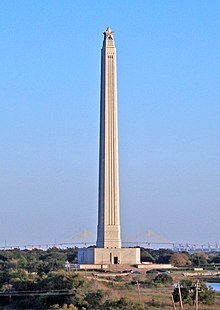
The San Jacinto Battleground State Celebrated Site was designated a National Celebrated Landmark in 1960.[115] The site includes the 570 ft (170 m)[116] San Jacinto Monument, which was erected by the Public Works Assistants. Authorized April 21, 1936, and dedicated April 21, 1939, the monument toll $1.5 million (equivalent to $28 million in 2022).[117] [118] The site hosts a San Jacinto Twenty-four hour period festival and boxing re-enactment each year in April.[119]
Both the Texas Navy and the United States Navy have deputed ships named subsequently the Battle of San Jacinto: the Texan schoonerSan Jacinto and 3 ships named USSSan Jacinto. In that location has been one civilian passenger transport named SS San Jacinto.
- Texas Navy schooner San Jacinto was commissioned in 1839 and decommissioned in 1840 after she was wrecked at Cayos Arcas.[120]
- The showtime USSSan Jacinto was a spiral frigate launched by the U.s.a. Navy in 1850. She was in service with the Africa Squadron in 1860 when she captured the slave ship Storm Rex. The frigate was in service for most of the American Civil War until she wrecked in the Bahama islands in 1865.[121]
- SSSan Jacinto was a Us civilian passenger send built in 1903 past the Delaware River Atomic number 26 Shipbuilding and Engine Works for the New York and Texas Steamship Visitor.[122] The U.S. Navy considered acquiring the civilian passenger-cargo ship for use during Globe War I as USS San Jacinto (ID-1531) simply never acquired or commissioned her. On April 21, 1942, the ship was sunk by a German U-boat.[123]
- The 2nd USSSan Jacinto was a United States Navy Independence-grade World War 2 low-cal aircraft carrier deputed in Dec 1943 and decommissioned in 1947.[124]
- The third USSSan Jacinto is a currently active guided missile cruiser commissioned by the U.South. Navy in 1988.[125]
When the veteran battleship USSTexas was decommissioned in 1948 and made into a museum ship, information technology was decided to give her a permanent anchorage near the San Jacinto Monument. Her arrival from Baltimore, where she was decommissioned, was timed for April 21, 1948 – the 112th anniversary of the Battle of San Jacinto.
Encounter as well [edit]
- Timeline of the Texas Revolution
Notes [edit]
- ^ Groce's Landing is located roughly nine miles (14 km) northeast of modern-mean solar day Bellville. Moore (2004), p. 149.
- ^ After getting inaccurate reports that several grand Indians had joined the Mexican army to assault Nacogdoches, American General Edmund P. Gaines and 600 troops crossed into Texas. Reid (2007), pp. 152–153.
- ^ Peggy Lake, too called Peggy's Lake, no longer exists. It was located southeast of the Mexican breastworks, which is now the site of the monument. Hardin (2004) pp. 71, 93
- ^ Lamar thought Houston was deliberately shot by ane of his men. Moore (2004), p. 339.
- ^ New Mexico, Sonora, and California revolted unsuccessfully; their stated goals were a change in government, not independence. Henderson (2008), p. 100. Vazquez (1985), p. 318.
Citations [edit]
- ^ "Picture and Central for "The Battle of San Jacinto" – Texas State Library and Athenaeum Committee". Tsl.state.tx.usa. Retrieved 2013-04-21 .
- ^ The official report of the battle claims 783. The more detailed roster published after the battle lists 845 officers and men simply failed to include Captain Wyly's Company, giving a total of around 910.
- ^ General Samuel Houston, Texan Officials, HQ of the Regular army, April 25, 1836 reproduced in the Daily National Intelligencer, Jun 11, 1836, Vol. XXIV, Issue 7280, p.ii, Washington, DC
- ^ Jackson, Wheat (2005), p. 28
- ^ Poyo (1996), pp. 42–43, "Under the Mexican Flag" (Andrés Tijerina)
- ^ Henderson (2008), pp. 86–87
- ^ Jackson, Wheat (2005), pp. 30–31
- ^ Jackson, Wheat (2005), pp. 49, 57
- ^ Jackson, Wheat (2005), pp. 38–39
- ^ Jackson, Wheat (2005), pp. 42–44, 208–283
- ^ Davis (2004), p. 143.
- ^ Todish et al. (1998), p. 121.
- ^ Menchaca, Poche, Matovina, de la Teja (2013), p. 63
- ^ "Surrender terms signed by Full general Cos and General Burleson at San Antonio, December 11, 1835". Texas State Library and Athenaeum Commission. Retrieved May 29, 2022.
- ^ Poyo (1996), p. 54, "Efficient in the Cause" (Stephen 50. Harden)
- ^ Calore (2014), p. 56
- ^ Todish et al. (1998), pp. 137–138
- ^ Hardin (2004), p. 15
- ^ Todish et al. (1998), p. 34.
- ^ Jackson, Wheat (2005), pp. 351–352
- ^ Hardin (2004), p. 25
- ^ Hardin (2004), p. 21
- ^ Groneman, Gill. "Green B. Jameson". Handbook of Texas Online. Texas State Historical Association. Retrieved June 25, 2022. ; Edmondson (2000), pp. 306–307; Jackson, Wheat (2005), pp. 367–368
- ^ Poyo (1996), p. 53, 58 "Efficient in the Cause" (Stephen 50. Harden); Lindley (2003), p. 94, 134
- ^ Jackson, Wheat (2005), pp. 366–367, 208–283
- ^ Hardin (2004), p. 53
- ^ Jackson, Wheat (2005), p. 372
- ^ Bishop, Curtis. "Battle of Agua Dulce Creek". Handbook of Texas Online. Texas State Historical Association. Retrieved May 29, 2022.
- ^ Hartmann, Clinton P. "James Walker Fannin Jr". Handbook of Texas Online. Texas State Historical Association. Retrieved May 29, 2022.
- ^ a b Hardin (1994), 161
- ^ Lack (1992), p. 83
- ^ Hardin-Teja (2010) pp. 64–66
- ^ Moore (2004), p. 14
- ^ Jackson, Wheat (2005), pp. 373–374
- ^ Moore (2004), pp. 37–38
- ^ Moore (2004), pp. 43, 48, 52, 57.
- ^ Moore (2004), pp. 55–59.
- ^ Moore (2004), p. 71.
- ^ Moore (2004), p. 60.
- ^ Davis (2006), p. 243.
- ^ a b Hardin (1994), p. 182.
- ^ a b Hardin (1994), pp. 183–184.
- ^ Moore (2004), pp. 71, 74, 87, 134.
- ^ Moore (2004), pp. 134–137.
- ^ a b c Hardin (1994), p. 189.
- ^ Davis (2006), p. 263.
- ^ Moore (2004), p. 185.
- ^ Davis (2006), p. 254.
- ^ Moore (2004), p. 154.
- ^ Moore (2004), p. 176.
- ^ Hardin (1994), p. 190.
- ^ Moore (2004), p. 182.
- ^ a b c Hardin (1994), p. 191.
- ^ Hardin (1994), pp. 190–193.
- ^ Hardin (1994), pp. 199–200.
- ^ Hardin (1994), p. 209.
- ^ a b c Hardin (1994), p. 202.
- ^ Hardin (1994), pp. 200–201.
- ^ Moore (2004), p. 258.
- ^ Moore (2004), p. 283.
- ^ Hardin (1994), p. 208.
- ^ Moore (2004), p. 287.
- ^ a b Hardin (1994), p. 203.
- ^ Hardin (1994), p. 204.
- ^ Davis (2006), p. 267.
- ^ Hardin (1994), p. 205.
- ^ Houston, 1836, op cit
- ^ Moore (2004), p. 292.
- ^ Moore (2004), p. 328.
- ^ Houston, Texian Army HQ Report from San Jacinto, 1836 op cit
- ^ a b c Houston, Texian Regular army HQ Report from San Jacinto, 1836, op cit
- ^ Moore (2004), p. 210.
- ^ Moore (2004), p. 211.
- ^ Davis (2006), p. 271.
- ^ Hardin (1994), p. 213.
- ^ Hardin (1994), pp. 211–215.
- ^ Davis (2006), p. 274.
- ^ a b Hardin (1994), p. 215.
- ^ Moore (2004), p. 364.
- ^ a b Davis (2006), p. 272.
- ^ a b Davis (2006), p. 273.
- ^ Davis (2006), p. 276.
- ^ Moore (2004), p. 353.
- ^ Hardin (1994), p. 216.
- ^ Hardin (1994), p. 245.
- ^ a b c Davis (2006), p. 277.
- ^ a b Hardin (1994), p. 246.
- ^ Davis (2006), p. 279.
- ^ Davis (2006), p. 282.
- ^ Lack (1992), p. 180.
- ^ Lack (1992), p. 245.
- ^ Moore (2004) p. 242
- ^ Henderson (2008), p. 103.
- ^ a b c Davis (2006), p. 288.
- ^ Davis (2006), p. 289.
- ^ https://www.thealamo.org/think/stories-of-texas-women/peggy-mccormick. Retrieved twenty July 2022
- ^ https://world wide web.tshaonline.org/handbook/entries/mccormick-margaret . Retrieved twenty July 2022
- ^ "Dunn, Jeff. "The Mexican Soldier Skulls of San Jacinto Battlefield". The Friends of the San Jacinto Battleground. Apr 1, 2022
- ^ a b Lack (1992), p. 201.
- ^ Davis (2006), p. 291.
- ^ Lack (1992), p. 206.
- ^ a b Vazquez (1985), p. 315.
- ^ Henderson (2008), p. 125.
- ^ Reid (2007), p. 169.
- ^ Henderson (2008), p. 123.
- ^ Henderson (2008), p. 127.
- ^ Lack (1992), p. 104.
- ^ Lack (1992), p. 107.
- ^ Lack (1992), p. 256.
- ^ Davis (2006), p. 295.
- ^ Davis (2006), p. 301.
- ^ Vazquez (1985), p. 316.
- ^ Vazquez (1985), p. 317.
- ^ Henderson (2008), p. 116.
- ^ "San Jacinto Battlefield". National Celebrated Landmarks. National Park Service. Archived from the original on Feb 26, 2022. Retrieved July 7, 2022.
- ^ "How Tall is it?". National Park Service. Retrieved July 7, 2022.
- ^ Buisseret, Francaviglia, Graves, Saxon (2009), p. 75
- ^ Moore (2004), p. 426.
- ^ "San Jacinto Monument". Texas Parks & Wildlife Department. Retrieved July 7, 2022.
- ^ "San Jacinto". Handbook of Texas Online. Texas State Historical Clan. Retrieved July 8, 2022.
- ^ Silverstone (2006), p. xv
- ^ "Mallory Line Twin-Screw Passenger and Freight Steamship San Jacinto". Marine Engineering science. Marine Engineering science Incorporated. 8: 547–554. November 1903.
- ^ Hampton Roads Naval Historical Foundation (2014), p. 71
- ^ Green (2015), pp. 56, 107
- ^ "USS San Jacinto". United States Navy. Retrieved July 8, 2022.
References [edit]
- Buisseret, David; Francaviglia, Richard; Graves, Jack West. Jr.; Saxon, Gerald (2009). Historic Texas from the Air. Austin, TX: Academy of Texas Press. ISBN978-0-292-71927-ix.
- Calore, Paul (2014). The Texas Revolution and the U.S.–Mexican State of war A Concise History. Jefferson, NC: McFarland. ISBN978-0-7864-7940-5.
- Davis, William C (2004). Lone Star Rising: The Revolutionary Birth of the Texas Republic . New York, NY: Free Press. ISBN978-0-68486-510-two.
- de la Teja, Jesus (1991). A Revolution Remembered: The Memoirs and Selected Correspondence of Juan N. Seguin. Austin, TX: State Firm Press. ISBN0-938349-68-half-dozen.
- Edmondson, J.R. (2000). The Alamo Story-From History to Current Conflicts. Plano, TX: Republic of Texas Press. ISBNi-55622-678-0.
- Light-green, Michael (2015). Aircraft Carriers of the United states Navy: Rare Photographs from Wartime Archives. Southward Yorkshire, U.k.: Pen & Sword Maritime. ISBN978-1-47385-468-0.
- Hampton Roads Naval Historical Foundation (2014). Naval Station Norfolk. Charleston, SC: Arcadia Publishing. ISBN978-1-4671-2027-2.
- Hardin, Stephen L; de la Teja, Jesús F. (2010). Tejano Leadership in Mexican and Revolutionary Texas. College Station, TX: Texas A & Grand University Press. ISBN978-i-60344-166-vii.
- Hardin, Stephen Fifty. (1994). Texian Iliad – A Military machine History of the Texas Revolution. Austin, TX: University of Texas Press. ISBN0-292-73086-1. OCLC 29704011.
- Hardin, Stephen (2004). The Alamo 1836 : Santa Anna's Texas campaign. Westport, CT: Osprey Publishing. ISBN978-ane-84176-090-2.
- Hardin, Stephen; McBride, Angus (2001). The Alamo 1836: Santa Anna's Texas Campaign. Oxford, Great britain: Osprey Publishing. ISBN978-1-84176-090-2.
- Henderson, Timothy J. (2008). A Glorious Defeat: Mexico and Its State of war with the Usa. New York, NY: Loma and Wang. ISBN978-0-8090-4967-7.
- Jackson, Jack; Wheat, John (2005). Almonte's Texas: Juan Due north. Almonte's 1834 Inspection, Secret Report & Office in the 1836 Campaign. Denton, TX: Texas State Historical Clan. ISBN978-0-87611-207-6.
- Lindley, Thomas Ricks (2003). Alamo Traces: New Evidence and New Conclusions. Plano, TX: Republic of Texas Press. ISBN1-55622-983-6.
- Menchaca, Antonio; Poche, Justin; Matovina, Timothy; de la Teja, Jesus (2013). Recollections of a Tejano Life: Antonio Menchaca in Texas History. Austin, TX: University of Texas Press. ISBN978-0-29274-865-i.
- Moore, Stephen L. (2004). 18 Minutes: The Battle of San Jacinto and the Texas Independence Campaign . Plano, TX: Republic of Texas Printing. ISBNane-58907-009-7.
- Poyo, Gerald Eugene (1996). Tejano Journeying, 1770–1850. Austin, TX: University of Texas Press. ISBN978-0-29276-570-two.
- Reid, Stuart (2007). The Undercover State of war for Texas. Elma Dill Russell Spencer Series in the West and Southwest. College Station, TX: Texas A&Grand Academy Printing. ISBN978-1-58544-565-iii.
- Silverstone, Paul (2006). Civil War Navies, 1855–1883 (The U.S. Navy Warship Series). New York, NY: Routledge. ISBN978-0-41597-870-five.
- Todish, Timothy J.; Todish, Terry; Spring, Ted (1998). Alamo Sourcebook, 1836: A Comprehensive Guide to the Battle of the Alamo and the Texas Revolution. Austin, TX: Eakin Press. ISBN978-1-57168-152-two.
- Vazquez, Josefina Zoraida (July 1985). translated by Jésus F. de la Teja. "The Texas Question in Mexican Politics, 1836–1845". The Southwestern Historical Quarterly. 89 . Retrieved Jan 21, 2022.
- Zamora, Emilio; Orozco, Cynthia; Rocha, Rodolfo (2000). Mexican Americans in Texas History: Selected Essays. Denton, TX: Texas State Historical Association. ISBN978-0-87611-174-1.
- https://world wide web.tsl.texas.gov/treasures/giants/seguin/seguin-01.html#:~:text=In%20Gonzales%2C%20Segu%C3%ADn%20organized%20a,Sam%20Houston%20and%20Edward%20Burleson.
- https://www.penguinrandomhouse.com/books/301368/harvest-of-empire-past-juan-gonzalez/
Further reading [edit]
- Winders, Richard Bruce (April iv, 2022). "'This Is A Cruel Truth, But I Cannot Omit It': The Origin and Effect of Mexico's No Quarter Policy in the Texas Revolution". Southwestern Historical Quarterly. 120 (four): 412–439. doi:10.1353/swh.2017.0000. ISSN 1558-9560. S2CID 151940992.
External links [edit]
- Battle of San Jacinto – Handbook of Texas Online
- Flags of Guerrero and Matamoros Battalions – Texas Country Library and Archives Commission
- San Jacinto Monument & Museum
- . . 1914.
- [1]

Source: https://en.wikipedia.org/wiki/Battle_of_San_Jacinto
Posted by: meyermolet1939.blogspot.com
0 Response to "Who Led The Texans In Drawing Santa Anna Into A Trap At The Battle Of Jacinto?"
Post a Comment